






Enterprises are under pressure to modernize networks for hybrid, multi‑cloud and AI workloads. This modernization and these new demands require critical services like DNS, DHCP and IP address management (DDI) to evolve—without disruption. Over the past quarter, Infoblox has expanded the Infoblox Universal DDI™ Product Suite and NIOS with new integrations, views and automation capabilities that help teams move faster, reduce risk and operate from a single, authoritative control plane.
This roundup highlights key updates across Universal DDI, and Infoblox NIOS, including:
- A better together approach to Microsoft DNS/DHCP management, allowing customers to modernize at their own pace
- Unified IP address management (IPAM) across AWS and Google Cloud, eliminating overlapping IPs and speeding hybrid deployments
- A broadened External Authoritative DNS portfolio that brings Infoblox resiliency and security to public‑facing services
- New NIOS 9.0.8 feature enhancements and Proxmox qualification
- Expanded automation with Swagger/OpenAPI, Terraform and VMware Aria to make both Universal DDI and NIOS more programmable and AI‑ready
- New Network and Address Space Perspectives and configuration management database (CMDB) reconciliation capabilities to improve visibility and data quality across hybrid estates
Advancing the Universal DDI Story
A recent survey by Enterprise Management Associates found 67.5 percent of respondents want full overlay management of native public cloud DNS in their core DDI stack.
Survey respondents indicated that one of their top DNS challenges was the lack of integrated management across on‑prem and cloud DNS. More than half had downtime in the last two years due to mismanagement of DNS, DHCP or IP address space, and more than 4 in 10 suffered a security breach tied to DDI mismanagement.
Directly aligned with these needs and challenges, in our November Universal DDI announcements, Infoblox expanded on our vision and strategy for transforming DDI into a unified, software as a service (SaaS)‑managed foundation for hybrid, multi‑cloud and AI‑driven IT. Universal DDI provides that foundation by:
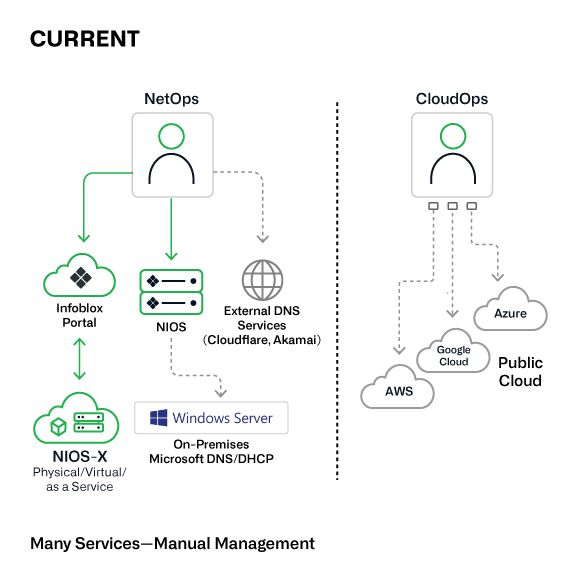
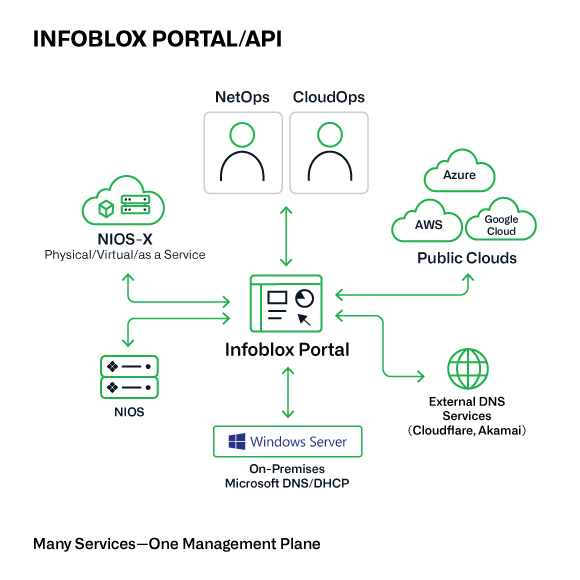
- Centralizing management of DNS, DHCP and IPAM across on‑premises NIOS, cloud platforms and external DNS providers through a single portal and API
- Breaking down silos between NetOps, CloudOps and SecOps so they can share data, policies and workflows instead of working from separate tools and spreadsheets
- Giving organizations an “AI‑ready” DDI layer, where rich DNS, DHCP and IPAM telemetry can feed analytics, security and automation platforms
This quarter’s updates, starting with several key capabilities that were first introduced in the November announcements, deepen that story with concrete ways to modernize legacy environments, unify IP management and harden external DNS without forcing disruptive rip‑and‑replace projects.
Modernize Microsoft DNS and DHCP at Your Pace
Many organizations still run DNS and DHCP on Windows Server, where those services are tightly coupled to Active Directory. That model was never designed for hybrid, multi‑cloud networks, but fully replacing it can feel too risky or expensive in the near term.
Universal DDI Management for Microsoft addresses this by letting customers modernize how they manage Microsoft DNS and DHCP—without forcing them to change where those services run. Universal DDI can now manage Windows Server DNS and DHCP configurations, alongside other cloud and external DNS services, via a single UI and API.
Businesses can immediately modernize and centralize the management of critical network services without disruption, and then follow a clear, low-risk path to evolving their DNS/DHCP architecture at their own pace.
Unifying IP Address Management across AWS and Google Cloud
Amazon VPC IPAM Integration: One Source of Truth for Hybrid IPAM
As organizations move workloads into AWS, IP address management is often split between on‑premises tools and the Amazon VPC IP Address Manager service. That can lead to overlapping IP ranges, slow provisioning and incomplete visibility.
The new Infoblox Universal IP Address Management™ integration with Amazon VPC IPAM closes that gap:
- NetOps uses Universal IP Address Management (IPAM) to allocate IPv4 blocks for AWS VPCs and write them into Amazon VPC IPAM from the Infoblox Portal, preserving a single, authoritative IP plan.
- CloudOps continues to work inside native AWS interfaces (Management Console, CLI, SDKs) while requesting address blocks that have already been validated as unique and conflict‑free.
- The integration automatically checks for overlapping ranges before assignments, reducing the risk of outages caused by conflicting IP space between on‑premises and AWS networks.
Combined with Infoblox Universal Asset Insights™, customers can correlate IP data with asset and security context across environments to improve planning, troubleshooting and governance.
Google Internal Range Integration: Smarter IP Planning in Google Cloud
In Google Cloud, rapid growth in VPCs, peering relationships and Kubernetes clusters makes it easy to lose track of which address blocks are used where—and to inadvertently introduce conflicts between cloud and on‑premises networks.
The Google Internal Range integration for Universal IPAM is designed to solve exactly that:
- Universal IPAM now discovers Google Cloud VPC networks and internal ranges, giving NetOps a single place to see how IP space is used across Google environments.
- NetOps teams can plan and reserve address blocks centrally in Universal IPAM, then define the corresponding Google internal ranges directly from the Infoblox Portal.
- The integration also surfaces VPC peering relationships and subnet mappings, improving visibility into how ranges are connected and helping prevent routing and overlap issues as environments grow.
Together, the AWS VPC IPAM and Google Internal Range integrations give customers a cohesive IP plan across on‑premises, AWS and Google Cloud, all enforced by a single Universal IPAM engine.
External Authoritative DNS: Unified Management, Security and Resilience
Critical customer‑facing applications—websites, APIs, SaaS services and email—depend on external authoritative DNS that often lives in different places than internal DNS. Historically, many organizations have:
- Hosted external DNS themselves on NIOS
- Used one or more SaaS DNS provider (e.g., Cloudflare, Akamai)
- Managed those environments separately from internal DNS and IPAM
The expanded Infoblox for External Authoritative DNS portfolio brings these worlds together and strengthens defenses at the same time. Key capabilities include:
- Unified DNS Management across Internal and External Environments
Universal DDI Management now supports DNS records not only for internal environments, Amazon Route 53, Azure DNS and Google Cloud DNS, but also for leading external DNS SaaS providers such as Cloudflare and Akamai. That means teams can:- See and manage DNS for internal networks, public‑facing apps and multi‑cloud environments through one API and the Infoblox Portal
- Apply consistent workflows and automation to changes, reducing configuration errors—the top cause of downtime in many environments
- Redundancy for External DNS
Many businesses rely on external DNS to keep their websites, email and other internet‑connected services online. But even the largest external DNS providers can experience outages. Infoblox eliminates this single point of failure with a hybrid-hosted external DNS architecture that runs SaaS‑hosted and self‑hosted DNS in parallel, so websites and public‑facing applications remain available even if a primary external DNS provider has a catastrophic outage. - DNS Infrastructure Protection for Self‑Hosted External DNS
For organizations that host their own external authoritative servers on NIOS, Infoblox DNS Infrastructure Protection (formerly Advanced DNS Protection, or ADP) provides adaptive defenses against volumetric and protocol‑level DNS attacks, such as distributed denial of service (DDoS), hijacking and cache poisoning. It is designed to keep legitimate queries flowing even while infrastructure is under attack, so web, email and other external services remain available.
By unifying internal and external DNS operations while hardening exposed infrastructure, customers gain clearer visibility across their digital estate and stronger business continuity in the face of outages or cyberattacks.
NIOS-X and NIOS-X as a Service Maintenance and Security Enhancements
To provide additional flexibility and control over updates, NIOS‑X now supports sequential software updates. Updates are applied to one server at a time across all update types, including scheduled updates, ensuring that each update completes successfully before the next begins. If you prefer a different approach for a specific maintenance window, you can temporarily disable sequential updates and then easily restore them for future cycles. For information, see Scheduling Software Updates for Servers.
New Perspectives in Universal IPAM and CMDB Reconciliation
As networks span more locations, clouds and business units, teams need better visual and analytical tools to understand where IP space is used and whether configuration data is trustworthy.
This quarter, Universal DDI introduces two new Universal IPAM perspectives and an important enhancement in Universal Asset Insights:
- Network Perspective provides a hierarchical view of IP networks and subnets across on‑premises and cloud, making it easier to see utilization patterns, fragmentation and potential overlaps.
- Address Space Perspective organizes IP usage by address spaces instead of physical topology, which is especially helpful for multi‑cloud and overlapping private ranges where traditional network diagrams fall short.
- CMDB Reconciliation (via Universal Asset Insights) compares ServiceNow CMDB records with live discovery data. Assets are automatically categorized as:
- Present in both ServiceNow and Infoblox (healthy)
- Listed in ServiceNow but not observed on the network (likely stale or decommissioned)
- Active on the network but missing from ServiceNow (coverage gaps)
These capabilities help teams clean up data, reduce blind spots and make better decisions about capacity, compliance and incident response.
Driving Agility through Automation: Swagger, Terraform and VMware Aria
In the same Enterprise Management Associates survey referred to previously, nearly two‑thirds of the respondents indicated that automated DDI management is “very important,” and over 97 percent call DDI automation at least somewhat important.
Automation remains a central pillar of Infoblox’s strategy for both Universal DDI and NIOS. As hybrid, multi‑cloud environments grow, manual workflows for DNS and IPAM simply can’t keep up with the speed of application delivery.
Recent automation enhancements include:
- NIOS Swagger/OpenAPI Support
Starting with NIOS 9.0.6, NIOS exposes OpenAPI‑compliant specifications and a Swagger UI experience for its APIs, giving developers an interactive way to discover endpoints, test calls in the browser and auto‑generate client SDKs. This lays the groundwork for AI‑driven automation that can interpret APIs programmatically. - Terraform Provider Updates for NIOS and Universal DDI
Infoblox has redesigned the Terraform Provider for NIOS, adding full API coverage and stronger resource validation to make infrastructure‑as‑code (IaC) deployments more reliable. At the same time, the Terraform Provider for Universal DDI now supports tag‑based filtering when requesting the next available address, subnet or block, improving flexibility in dynamic, multi‑cloud environments. - VMware Aria Automation Provider for Universal DDI
A new VMware Aria Automation Provider integrates Universal DDI directly into VMware Aria workflows, automating IP allocation, DNS record creation and DHCP reservations as part of virtual machine provisioning and deprovisioning. This reduces manual steps, cuts configuration errors and ensures critical network services are delivered consistently as virtual infrastructure changes.
Together, these automation capabilities help customers reduce manual work, standardize workflows and plug DDI into their broader continuous integration (CI)/continuous delivery (CD), cloud and orchestration pipelines, across both Universal DDI and NIOS.
NIOS 9.0.8 and the Long‑Term Support Experience
NIOS remains a cornerstone for customers that rely on robust, on‑premises and virtualized DDI deployments. Recent updates balance more deployment choice with an improved support and upgrade model.
NIOS on Proxmox: More Choice for Virtualized DDI
With NIOS 9.0.8, Infoblox has qualified NIOS on Proxmox Virtual Environment (VE), adding another option alongside VMware, KVM, Nutanix, OpenStack and others. This is particularly valuable for organizations:
- Looking to diversify away from a single hypervisor vendor for cost, control or risk reasons
- Standardizing on Proxmox—an open‑source platform that tightly integrates KVM and Linux containers (LXC), offers SDN, high availability (HA) and both REST API/CLI and web UI options
Infoblox Engineering has validated NIOS on Proxmox in the lab and in coordination with internal IT teams that were already adopting Proxmox, confirming consistent performance and behavior compared to existing KVM deployments.
Long‑Term Support (LTS) for NIOS: Streamlined Upgrades and Fewer Surprises
Alongside feature releases, Infoblox has also introduced a Long‑Term Support (LTS) program for NIOS, beginning with the 9.0.6 release train. The program is designed to make it easier for customers to plan upgrades and maintain a stable, secure DDI foundation:
- Two‑year support lifespan from the release of each new LTS version, giving customers a predictable window for planning upgrades
- A unified update experience that replaces separate paths for major upgrades and consolidated hotfixes (CHFs), simplifying maintenance and reducing the potential for errors
- An improved upgrade workflow that automatically checks for configuration issues (such as invalid certificates or misconfigurations) before upgrades proceed, helping prevent failed change windows
- Richer logging during upgrades, enabling Infoblox Support to troubleshoot more quickly if problems arise
For customers deploying NIOS 9.0.8 on Proxmox or other hypervisors, pairing those capabilities with the LTS program gives a clear path to modern, resilient DDI with fewer upgrade events.
Universal DDI 26.2 Release Updates
The latest 26.2 release adds several capabilities that further strengthen resiliency, multi‑cloud reach and operational visibility across Universal DDI and NIOS‑X:
- NIOS‑X: DHCP Ping Before Offer
NIOS‑X DHCP servers can now verify that an IP address is not already in use before offering it to a client. By probing the candidate address and automatically skipping any IPs that are active on the network, this feature helps prevent conflicts in environments with unmanaged or manually configured devices and improves overall stability for end users. - Universal DDI: Microsoft and NIOS DHCP Lease Visibility
Universal DDI now discovers and surfaces DHCP leases from both Microsoft and NIOS DHCP servers in the Infoblox Portal. This unified, real‑time lease visibility simplifies troubleshooting, accelerates root‑cause analysis and enables richer on‑premises reporting across mixed DHCP environments.
What Does It All Mean?
Taken together, these innovations show how Infoblox is executing on a clear vision, strategy and roadmap:
- Modernize without Disruption: Start by centralizing management of Microsoft DNS/DHCP and external DNS, then evolve underlying infrastructure on your own timetable.
- Unify IP Visibility across Every Cloud: Use Universal IPAM and integrations with Amazon VPC IPAM and Google Internal Range to maintain a single IP source of truth across AWS, Google Cloud and on‑premises networks.
- Automate Everything You Can: Leverage Swagger/OpenAPI, Terraform and VMware Aria integration across both Universal DDI and NIOS to move DNS, DHCP and IPAM firmly into your automation toolchain.
- Stabilize Your Core with LTS: Adopt NIOS Long‑Term Support releases to reduce upgrade frequency, gain more predictable support windows and improve reliability during change events.
Customer Spotlight: Standardizing DNS at a Global Infrastructure Provider
A global operator of critical internet infrastructure recently completed a comprehensive evaluation of commercial DDI platforms. The engagement began as a paid proof‑of‑concept focused on whether an enterprise‑grade DDI solution could meet stringent requirements for availability, scale and operational simplicity. Over time, that assessment evolved into a strategic platform decision.
The customer ultimately chose Infoblox to replace a large, internally built BIND deployment and establish a standardized DNS foundation across multiple data centers, with a clear path to expand and layer on additional capabilities such as security services. Infoblox differentiated itself by:
- Demonstrating resilient, highly available DNS at scale with richer features and easier day‑to‑day management than the in‑house solution or alternative vendors could provide
- Showing that DNS could be delivered as a reliable, service‑oriented platform, rather than a collection of manually maintained servers and configurations
Equally important, Infoblox successfully navigated the customer’s rigorous vendor qualification process, including extended review of service terms, detailed security posture assessments and strict supplier requirements.
Being selected by yet another industry leader illustrates how Universal DDI and NIOS can address both the technical and governance expectations of highly regulated, risk‑sensitive organizations.
Learn More
To dive deeper into this quarter’s innovations:
- Review the November announcement: Building More Resilient, AI-Ready Networks with Infoblox Universal DDI™ and related materials.
- Read the product‑specific announcements for more detail:
- Amazon VPC IPAM integration for cross‑team IPAM in hybrid AWS environments
- Google Internal Range integration for unified IPAM in Google Cloud
- External Authoritative DNS for unified management, DNS Infrastructure Protection and brand defense
- NIOS on Proxmox for broader virtualization choice in on‑prem and lab environments
- Driving Agility through Automation for Swagger/OpenAPI, Terraform and VMware Aria updates
- Visualize ServiceNow CMDB Accuracy for authoritative asset inventory
- Talk with your Infoblox or partner account team about where to start, whether that’s modernizing Microsoft DNS/DHCP management, unifying IPAM across clouds, hardening external DNS or adopting NIOS 9.0.8 and the LTS program as a stable base for future growth.
By simplifying, unifying and protecting how you deliver DNS, DHCP and IPAM across every environment, Infoblox helps you build the resilient network foundation your business needs for whatever comes next.