This paper describes the ways that NetMRI can help you quickly achieve and maintain PCI DSS compliance across your network. NetMRI can manage and monitor the many demands of PCI DSS by automatically performing security audits, configuration updates, and policy compliance verification on IT infrastructures of any size.
Explaining why network analysis is important is always interesting. To help bridge the gap between the business person and network engineer, Infoblox created this poster that shows the top 25 network problems and describes how each problem impacts the business.
When asked to identify the No. 1 cause of network performance problems, IT organizations typically point to denial-of-service attacks, computer viruses, fiber cuts, power outages and hardware failures—the events that receive the most publicity and media coverage. However, studies by research firms such as Gartner Group and Enterprise Management Associates indicate that over two-thirds of network issues are actually tied to seemingly simple everyday activity: the process of IT staff making network configuration changes.
Organizations have made dramatic improvements in efficiency and customer satisfaction by breaking down application and database silos. By linking Customer Relationship Management (CRM) systems with order status, inventory and logistics systems, for example, customers can see product availability and track their shipments accordingly. Organizations gain can through reduced inventories, shortened delivery times, and lower customer support costs. Customers benefit from an improved shopping experience.
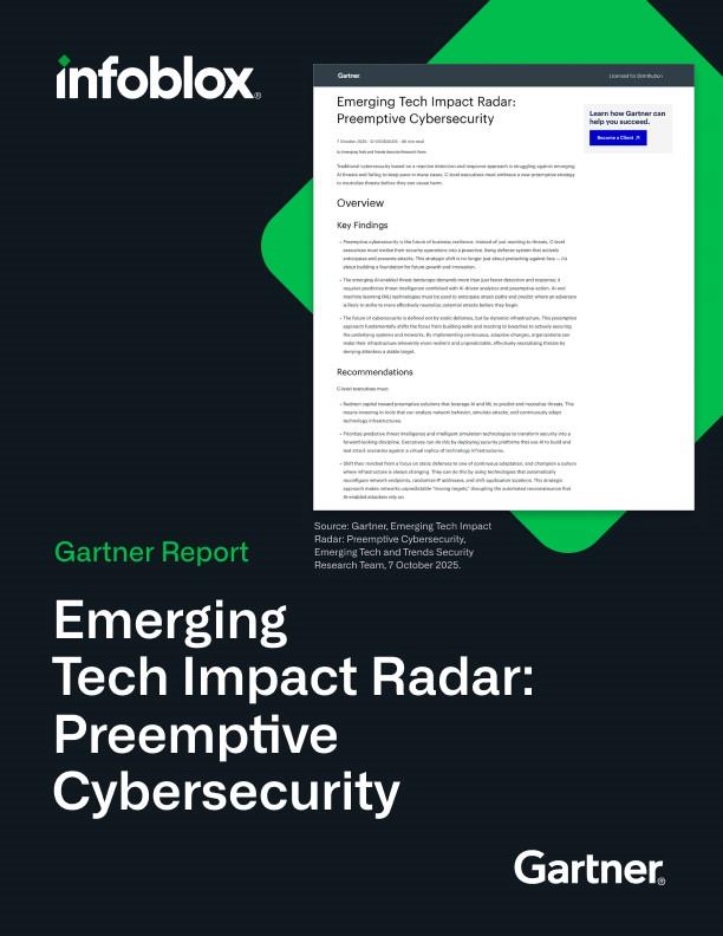
Read Gartner’s first MarketScope for the emerging DNS, DHCP and IPAM (DDI) appliance market, driven by an explosion in IP addresses and the increasing awareness of the “mission critical” role of DNS and DHCP services. This report was published in November of 2009.
Infoblox Acquires Netcordia, Takes Aim at Network Infrastructure Automation
IDC Flash analyzes Infoblox's acquisition of Netcordia
DNSSEC is poised for explosive growth in adoption in 2009 and 2010. Your team can be better prepared by reviewing this general overview of the concepts behind DNSSEC, the state of adoption and the implications for DNS architectures by leading DNS authority Cricket Liu.
IPAM provides the ability to effectively manage, control, monitor and assign the IP address space within a company. To provide effective IPAM, it is essential to control the two key services within a company that provide the naming and delivery of IP addresses—which are DNS and DHCP—as well as to supply the feature sets necessary to generate and present reports detailing IP address information and usage. In this paper, we will explain the importance of IPAM, discuss the expense impacts of legacy IPAM and spreadsheet management, and explain some of the features and advantages of the Infoblox IPAM solution.
Infoblox solutions on Riverbed Steelhead appliances provide customers best-of-breed core network services and WAN optimization on a single platform.
What is the "True" cost of acquisition? This white paper compares the acquisition costs of general-purpose servers running Windows Server 2003 Standard Edition vs. Infoblox appliances deployed in the branch office. With the introduction of the Infoblox-250, the difference in acquisition costs has been greatly reduced, thereby, providing additional impetus for making the shift to appliances.
As “round-the-clock” business continuity becomes increasingly critical, organizations need to consider the importance of core network services to the continuous availability and, in the event of a disaster, recovery of every application on the network.
To ensure the resiliancy of your core network systems this white paper give you options to consider regarding implementation, graphical user interface(GUI), anycast, and grid configuration to name a few.
Networks and applications have become highly dependent on a collection of essential core network services that are not always “visible” or on the forefront of IT project lists. For example, virtually all applications, including web, e-mail, ERP, CRM, and Microsoft’s Active Directory require the Domain Name System (DNS) for their basic operation. Most IP-based devices, including laptops and desktops, require Dynamic Host Configuration Protocol (DHCP) to obtain an IP address. Newer devices such as IP phones, RFID readers, and cameras that are network-connected require file transfer services (via TFTP or HTTP) to receive configuration information and firmware updates. If core network services are compromised, networks and applications fail.
Infoblox appliances deliver core network services—including DNS, DHCP, IPAM, TFTP, and RADIUS—in reliable, secure, easy-to-deploy and manageable platforms. Infoblox grids are created by linking appliances together across a distributed enterprise. The grid is not a separate management and reporting application that overlays the individual appliances. Rather, appliances in an Infoblox grid are linked using sophisticated distributed database technology embedded within each appliance. This transforms the collection of appliances into a unified system with very unique and beneficial attributes.
Infoblox NIOS™ software solves a growing, critical problem in enterprise networking: keeping core network services infrastructure—the core protocols and services that store and deliver information about users, devices, and policies for all IP applications—running nonstop. This infrastructure is the foundation that supports new security initiatives, pervasive mobile networking, convergence applications like VoIP, and growing compliance reporting requirements.
Essentially all IP applications—web browsing, e-mail, VoIP, wireless, and many more—rely on the availability of robust DNS and DHCP services. With Active Directory's dependence on DNS as a core service, this reliance is further increased. Offloading DNS and DHCP services from domain controllers onto Infoblox appliances is easy and improves security, reliability, and availability—while simplifying and enhancing manageability and greatly reducing operating costs.
While many of the principles in this design are agnostic of how DNS is deployed, appliances have provided the ability for companies to deliver this architecture as core network infrastructure—a significant leap in how DNS is deployed and managed. As with other network infrastructure, DNS appliances offer better reliability and security than name servers based on general-purpose operating systems, as well as significant features including high availability, powerful management interfaces, and easy backup and restore. As companies revisit and revise their DNS architectures in light of the increased importance of DNS as a network service, appliances should be considered as the key delivery mechanism for companies that want to optimize management and cost-effectiveness, enhance the security of their networks, and build a scalable, reliable platform for future network growth.
DNS has evolved into the de facto standard naming service on corporate networks. While organizations have come to rely on DNS to support their everyday business applications, the protocol and its implementations have grown in complexity. The service has also become a favorite target for hackers. This makes managing and securing an enterprise DNS infrastructure at once both imperative and challenging. Forward-looking enterprises that adopt appliances for DNS can reap the rewards of more reliable, more secure, and yet less costly DNS infrastructure that provides the foundation for today’s critical business applications and those to come.
External name servers provide two important services to a corporate network: Resolving Internet domain names, usually on behalf of internal resolvers and name servers; and answering queries about the company’s domain names for name servers on the Internet. Cricket Liu, author of DNS and BIND, discusses the critical nature of external name servers and examines the practice of using common makes of name servers in that role, as well as Infoblox's NS1® appliance-based solution.
ITIL is emerging as the standard way of managing IT service delivery; the latest v3 has extended this, aligning service design, development, and delivery more closely with business goals. Organizations implementing ITIL usually get good results, in terms of service design, delivery, and reliability. This paper explains some of the objectives outlined in ITIL v3, and how one product in particular—Infoblox’s NetMRI network analytics engine—is uniquely positioned to help organizations comply with ITIL with minimum preparation and investment.
While basic software claims to meet your needs, in the real world, the risk of unintended consequences is huge for most organizations. NetMRI provides the intelligence, analysis and embedded expertise to solve the hardest problems for IT professionals today—and the basic software solutions would never see. NetMRI helps you stop being reactive and chasing problems after the fact—and isn’t that what every networking professional really wants? This paper will highlight the common approaches to managing network configuration and change today, the capabilities and limitations of basic configuration software tools and the top ten reasons Infoblox’s NetMRI system far exceeds the capabilities of basic software and adds more value to your organization.