- infoblox:blogs/tags/domain-impersonation-threats
Infoblox is Pleased to Announce the Brand New Infoblox NIOS Collection for Ansible
Infoblox offers various automation tools that can be used to optimize your company's network. Learn about Infoblox's new NIOS collection for Ansible here.

The Brief
The Red Hat Ansible Automation Platform is a popular open-source automation tool, or platform, used for IT tasks such as configuration management, application deployment, interservice orchestration, and provisioning. Ansible extends beyond traditional tools for server and software installations to encompass the entirety of IT infrastructure, including network resources.
With the new Infoblox NIOS Collection for Ansible, organizations can maximize their cloud investments by automating core network services.
The Need for Network Automation
Traditionally, IPAM has been done via spreadsheets. The network administrators maintained the IP address landscape, where they manually added or deleted IP addresses from the spreadsheets whenever hosts are added or deleted from the network. That doesn’t work in today’s dynamic environments and makes the entire IPAM lifecycle management tedious and prone to error. In large organizations, end-users might have to submit internal tickets for IP address record fulfillments that can take hours, if not days. And then there is the cleanup – again, a time consuming and error-prone effort. The result? These legacy approaches often delay workload deployments and diminish the automation and orchestration advantages that organizations wanted.
The Infoblox NIOS Collection for Ansible Automation Platform is a package of modules and plugins that allows managing Infoblox Network Identity Operating System (NIOS) objects and functions through APIs leveraging Ansible playbooks. Dynamic inventory is one of the powerful features in Red Hat Ansible Tower, which allows Ansible to query external systems and use the response data to construct its inventory. The combined Infoblox/Red Hat solution enables network professionals to overcome the burden of maintaining a static registry of devices and gain a centralized and highly efficient way to manage DNS, DHCP, and IPAM (DDI) automation of VMs and containerized workloads deployed across multiple platforms.
Infoblox and Ansible Integration Benefits: Enhancing the Ansible Experience
The Infoblox NIOS Collection for Ansible provides 16 modules and four plugins included with Ansible 2.9. It enables networking teams to leverage Ansible NIOS modules and plugins to automate Infoblox Core Network Services for IPAM, DNS, and inventory tracking for workloads deployed across multiple platforms. It frees network administrators from frequent repetitive requests or tasks with high error rates, including IP address assignments, DNS record creation, and cleanup of everything once a resource is no longer needed.
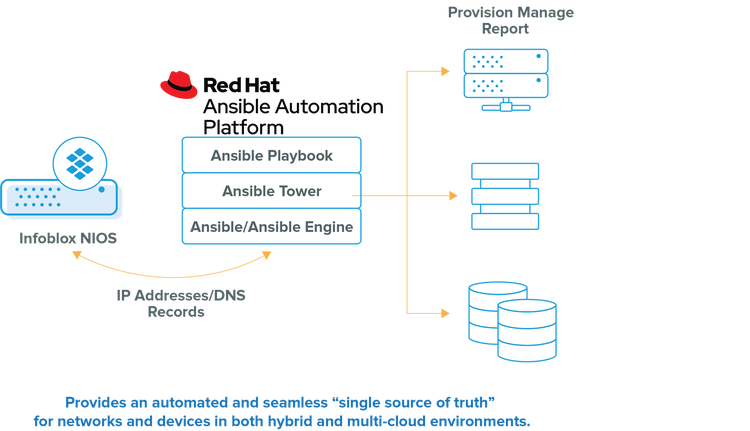
The Infoblox NIOS Collection for Ansible provides single-point comprehensive VM automation and containerized workload deployments across multiple platforms. By integrating Infoblox DDI capabilities with Ansible automation, organizations can:
- Reduce Time to Deployment. Scripting the provisioning of IP addresses and DNS records in an Ansible Playbook reduces the elapsed time to bring a networked device and its attendant capabilities online. Rather than rely on human intervention and manual processes, this becomes a “push button” function within a Playbook.
- Use Network Resources Efficiently. Infoblox DDI provisions and recovers IP address and DNS records for networked devices, such as servers. By automating these tasks, managing IP addresses and DNS records is made efficient, while bringing devices onto a network is less exposed to address conflicts.
- Improve Network Reliability. Automating reduces the probability of random human error in network service provisioning and management. Fewer errors lead directly to greater network reliability, and indirectly to better user experiences with applications running on that network.
- Leverage Existing Skills and Investments. Ansible is used by thousands of organizations to manage data center resources. DDI network services can now be seamlessly automated using Ansible’s well-understood scripting language, rather than introducing new tools that require new skills.
- Single Pane of Glass. By consolidating network service management within an Ansible playbook, the data center or network administrator has one less system to learn, use, and maintain.
Use Cases
With the Infoblox NIOS Collection for Ansible, organizations can confidently handle the most challenging DDI requirements in every type of network, data center, and hybrid cloud environment.
- Provision systems in minutes, instead of days, with automated IP address provisioning for cloud infrastructure and services by enabling automatic IP allocation/deallocation and DNS records creation/deletion as applications or services are spun up and shut down.
- Leverage the next available IP address capability to assign the right IP addresses to the resources spun up.
- Simplify troubleshooting and reduce downtime with real-time visibility into virtualized and physical network infrastructure.
- Configure and manage NIOS objects such as networks, network views, and zones, directly from Ansible via playbooks.
- Leverage the lookup plugin to query for NIOS objects.
- Manage movement between VM and container clusters easily synchronizes critical DNS, DHCP, and IP address services.
- Import your network node inventory from Infoblox NIOS using Infoblox dynamic inventory plugin.
- Autoscale Infoblox Grid Members based on DNS traffic on the fly when high DNS queries and low cache hit ratios occur (which is an excellent use case for communications or mobile service providers in the build-out of 5G).
Learn More
Don’t just take my word for it. To get started, take a look at the Ansible Automation Hub (Red Hat account registration required) or the Infoblox NIOS Collection for Ansible on GitHub.
Watch this video to get a quick overview of the Infoblox DDI integration with Ansible. You can also check out this deployment guide or the Ansible Infoblox Guide to understand how to automate Infoblox DDI using Ansible.