- infoblox:blogs/category/infoblox-threat-intel
Dark Side of the PhaaS: The Backend Services Powering Stolen Device Unlocks
The phishing kit is the cheap part. The services behind it are where the money and the leverage sit.
Executive Summary
Our investigation of the stolen-device economy began with a stolen iPhone and a suspicious text message. Following that message through DNS led us to more than 10,000 associated domains and an international marketplace for tools that help thieves turn locked phones back into sellable hardware. We documented unlock and phishing kits, the front-end panels used to operate them, resellers, and the social-engineering workflow. We also learned that the attackers were usually after the device, not the data.
That work left another question open: What keeps these kits running?
This time, we followed the code out of the kit and into the services it depends on. Operators may choose to purchase and manage a full unlock and phishing kit or keep things simple and rent front-end panel access from another operator for as little as $35 a month, down from $100 in 2023. But the real business lies in the metered services these kits depend on, charging credits for every text message, call, and unlock (Figure 1).
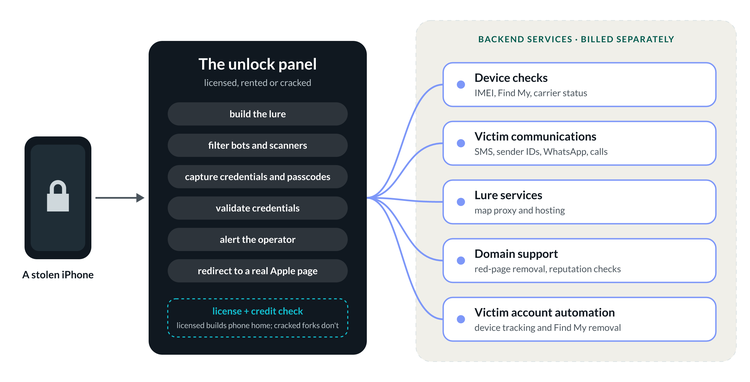
Figure 1. One unlock job, one front-end panel, multiple backend services working out of sight
We found a separate backend economy selling specialized services that make the operation work: messaging, voice calls, maps, device checks, credential validation, account removal, and infrastructure support. These services are independently metered and can support multiple unlock and phishing kits. The domains hosting backend services tend to persist much longer than the domains hosting their front-end panels and lures.
The clearest evidence is the lifespan gap. We studied several variants of a kit called iRealm. Half of the tracked front-end panel domains disappeared within roughly 60 days. But the observed backend-service domains had a median lifespan of about 540 days, with the oldest dating back to 2019. While there is an endless stream of front-end panel and lure domains, the backend infrastructure is stable and much smaller.
We can now see where specialized capabilities sit outside the kit, how providers monetize them, and how DNS exposes the service providers and infrastructure supporting those kits. A lure domain may identify one campaign. A shared dependency can reveal many more. For defenders, these shared dependencies offer a more persistent target than the front-end panel and lure domains used by individual unlock and phishing kit operators.
Your Phone has been Found
The phone may be gone but it has not been forgotten. Not long after the theft, the owner gets a message on another device (Figure 2). Good news: the lost phone has been found. Just tap to see where!
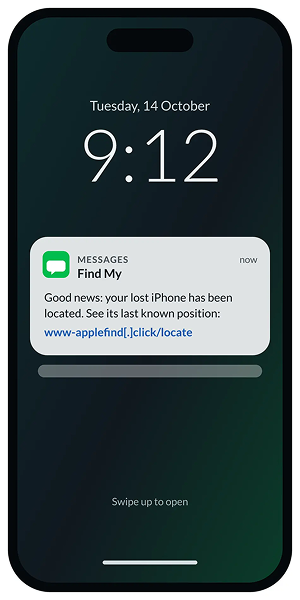
Figure 2. Screenshot of an example lure message: “Good news: your lost iPhone has been located”
The lure looks like Apple’s Find My service. It has a map, the right logos and a plausible location. It may ask for an Apple Account password, a device passcode, or both. Enter the wrong password and the lure will return Apple’s real error message. Enter the right one and the operator has what they came for.
The phishing lure is the part the victim sees. Behind it is an entire operation.
When we first investigated this ecosystem, we followed one stolen iPhone into an international marketplace for tools designed to separate phones from their owners. We found more than 10,000 associated domains, dozens of sellers, and a polished workflow for turning a locked phone back into sellable hardware. The research showed how operators configured false Find My pages, sent targeted messages and used captured credentials or passcodes to remove account protections.
This time, we went through the kit and out the other side.
Same Kit, Different Day
To unlock the phone, the thief needs the owner's Apple ID password and, in many cases, device unlock codes, so they acquire an unlock and phishing kit or rent access to one through another operator’s front-end panel. Raptor Dark, VMT-Unlock, Nefi-Server, and UnlockPro are four examples of such kits from a crowded market, each allowing access via a branded front-end panel (Figure 3). Based on the code, functionality, and kit structure we observed, many of the kits encountered during our research appear to be variants or rebrands of the iRealm kit family, differing mainly in branding, language, and presentation. Some may have been sold as licensed builds, while others have likely been circulated as cracked or modified forks in underground channels.
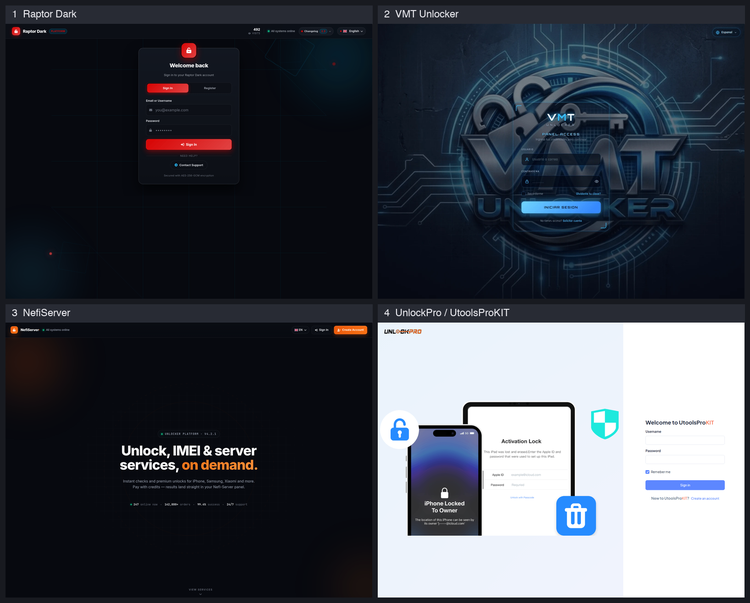
Figure 3. Examples of branded front-end panels used to access iRealm-family kits
iRealm, which appears to be one of the more widely adopted families of unlock and phishing kits in this ecosystem, is only part of the picture. We also traced activity linked to the Nj0rd and Panther families. While each has its own distinct code base, set of operators, and development history, they all follow strikingly similar playbooks. Despite their differences, they rely on similar third-party services, both illicit and legitimate, to support tasks such as messaging, device checks, account removal, and infrastructure management.
The Kit Doesn’t Work Alone
The front-end panel is where the unlock and phishing kit workflow is handled. It builds the lure, filters bots and scanners; captures passwords, two-factor authentication codes and device passcodes; checks credentials against Apple’s services; and alerts the operator when a victim responds. If a password is entered incorrectly, the victim is shown Apple's genuine error message and invited to try again. Once the operator has what they need, they typically redirect the victim to a legitimate Apple page.
Most of the functions that make the operation profitable, beyond the eventual resale of the physical device, are provided by third-party services. Rather than handling everything internally, kits typically rely on external services for key parts of the workflow. Some services help identify and assess the status of stolen devices; others help reach victims, keep lure domains online, validate credentials, or automate account-removal tasks.
Every service has its own business model, but most ultimately charge recurring subscription fees or per-action credits.
In the case of some iRealm kit variants, the front-end panel appears to phone home to its author or reseller to validate a license and track credit balances. Cracked forks remove this license check, but not the kit’s dependency on paid third-party services. A cracked kit may cost the operator nothing, but the services it depends on still do.
Seller advertisements also suggest how the economics have shifted. Rental prices to access front-end panels have fallen sharply over the last few years, while supporting services continue to generate revenue through subscriptions and usage-based fees.
Many Kits, Few Vendors
The kits differ, but they tend to rely on the same categories of supporting services. Across the families we analyzed, a handful of recurring functions are performed by various backend services:
- Autoremove: signs in using the victim's credentials and removes the device from Find My, which lifts Activation Lock
- Messaging services: provide SMS gateways, sender-ID services, WhatsApp relays, and voice-calling platforms used to reach the victim
- Device-check APIs: validate IMEI, carrier, and Find My status before an attack begins
- Maps proxies: provide the map displayed on fake Find My pages
- Hosting and management services: provide panel hosting, configuration delivery, and scanner block lists that help keep campaigns running
Different kit families may use different providers, but the functionality remains remarkably consistent (Figure 4).
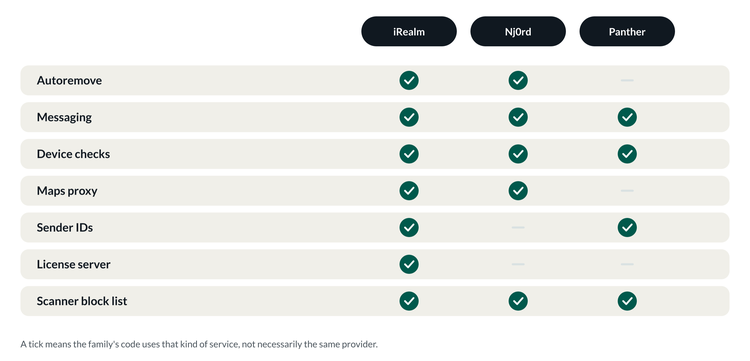
Figure 4. Backend service functions found in each kit family's code
This is why the backend services matter. Kits can be copied, rebranded and deployed with relative ease. The backend services they rely on tend to persist far longer. However they are delivered, functions such as messaging, device checks, credential validation, and account removal remain fundamental to the ecosystem.
One Vendor, Up Close
To see how this works in practice, let’s take a closer look at Holly, a provider operating under domains such as hollyrenew[.]website and hollysms[.]store. We first encountered Holly through a service referenced in a kit PHP file. Following that reference revealed a broader ecosystem of interconnected offerings supporting device-unlock and phishing operations, with services used by both the iRealm and Nj0rd families.
Their certificate history and passive DNS (pDNS) records read less like infrastructure and more like a product roadmap. Between September 2024 and June 2025, the operator expanded from autoremove, SMS delivery, and Find My checks into a broader service portfolio that included payment processing, carrier checks, device checks, and domain cleaning. Multiple service lines appeared in just nine months (Figure 5).
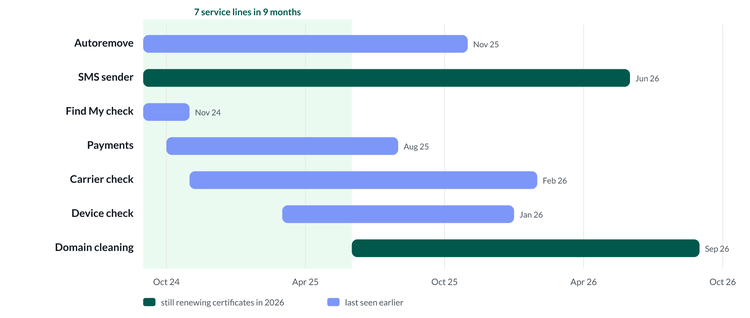
Figure 5. The Holly service ecosystem as observed through certificate logs and passive DNS records. Seven service lines appeared over nine months; SMS and domain-cleaning services were still renewing certificates in 2026.
The Holly service ecosystem, like others in this market, provides functions that kit authors might choose not to build or operate themselves, or not to expose directly in the kit. By moving those capabilities into shared backend services, operators keep critical functionality outside the distributable kit.
Take mapping, for example. To make lure pages look more convincing, fake Find My pages often display the supposed location of a stolen device on a map (Figure 6). Rather than loading that functionality directly from Google, some kits retrieve it through a backend maps proxy. The service supplies the Google Maps loader and API key on behalf of the kit, allowing operators to share infrastructure that would otherwise need to be acquired and maintained individually. This allows operators to present a convincing Find My page that can automatically zoom to specific coordinates, reinforcing the illusion that the device has genuinely been located before prompting for credentials.
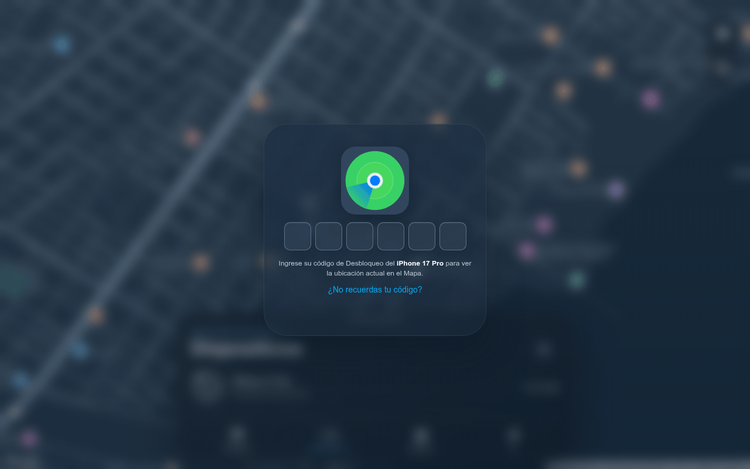
Figure 6. Screenshot of a site displaying a Find My map location lure associated with the Nefi server. The site displays the general area of the phone’s supposed location and then prompts the victim for their Apple unlock code to see the exact location.
The mapping service is monetized too. When an operator has not registered with the service, or payment is pending, the maps proxy returns a payment notice instead of map data. The notice directs the operator to contact the vendor via Telegram and arrange payment of $50 in Tether (USDT). That is who can flip the switch.
Holly also provides credential-validation services. Captured Apple credentials are submitted to the service, which validates the login and returns a result to the kit. Depending on the response, the victim may be shown the kit’s own error message and asked to try again, or moved on to the next stage of the ruse.
The relationship between backend services and kits goes deeper than shared functionality. DNS ties the Holly ecosystem directly to the infrastructure used by the Nj0rd family. Several Holly-branded services resolve to the same server as older Nj0rd backend infrastructure, as well as a fresh series of related domains registered in October 2026. The shared hosting alone does not prove a common operator, but it does place vendor infrastructure alongside components used by the Nj0rd ecosystem.
One IP address. Shared infrastructure, shared interests, or both.
Reaching the Victim
For many vendors, the real business is reaching the victim. SMS senders, sender-ID services, WhatsApp relays, and automated calling platforms exist to get victims to the lure and keep the attack moving.
As with the device-checking and autoremove services, these functions are increasingly offered as standalone services that can be rented by kit operators as needed.
A sender-ID shop lets the text arrive under a trusted name; four out of five accounts we could trace for one such provider were associated with the phone-unlock trade. A hosted WhatsApp relay integrates directly into unlock and phishing kit workflows. In one instance, we observed 63 sessions linked to the attackers’ own WhatsApp accounts for bulk messaging. A calling service, sold through the iRealm family's own channels in $50, $100 and $300 packages, places the voice call that asks for a device unlock code, with prompts selectable by language and passcode length.
The voice lures observed ranged from predefined recordings selected through the front-end panel to customized, AI-generated messages. In one sample we recovered, the message was customized with the victim's name, iPhone model, and required passcode length, and referenced a location associated with the purported suspicious activity. The wording also offered a "tap help" option, suggesting the message could be delivered through an interactive messaging channel such as WhatsApp.
A second sample shows the more traditional approach: a predefined "Apple Support" recording selected from templates available within the panel (Figure 7). The recording references the device model and required passcode length, claims that a request has been made to locate the lost device, and asks the victim to enter their passcode to receive its current location.
Figure 7a and 7b: Audio samples of a customized AI-generated lure and a predefined Apple Support-style voice template; victim information has been redacted
Even the Clean-up is Rented
As we noted in our earlier research into the stolen-device unlocking ecosystem, maintaining phishing infrastructure is almost as important as deploying it. Operators invest significant effort in keeping lure domains online and restoring access when they are flagged or blocked.
That maintenance has become a service in its own right. Red-page removal services, named after the warning pages shown by Google Safe Browsing, monitor domains for detections and offer to get those warnings cleared. One service we observed starts at around $80 per domain per month (Figure 8).
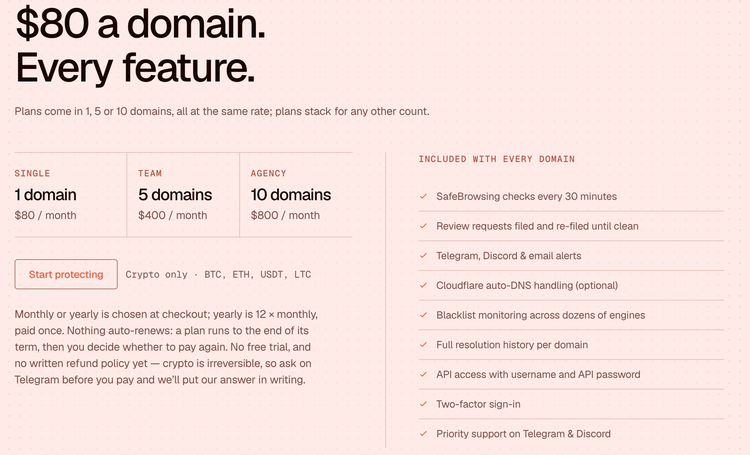
Figure 8. Screenshot of example pricing and features from the red-page removal service ‘remove[.]red’. The service monitors domains for blocklist detections, automates review requests and can temporarily withdraw infrastructure until warnings are removed.
These services continuously monitor domains for Safe Browsing and other blocklist detections, automatically file and re-file review requests, and alert operators through Telegram, Discord, and email. Some can also integrate with hosting panels or DNS providers to temporarily take a site offline while a review is underway, restoring service automatically once the warning has been removed.
Around that sits an ecosystem of reputation checks, scanner screening, uptime monitoring, and pools of spare domains.
Keeping a lure domain alive is a product line like any other.
Following the Money
Count who gets paid for a single stolen phone. The thief profits from reselling the unlocked device. The phishing operator rents access to the kit through a front-end panel, assuming they didn’t acquire a cracked copy. Advertised prices fell from around $100 per month in 2023 to $35 per month in 2026. Supporting the kits are service providers that charge for messages, calls, device checks, and account removals across the operators that use their platforms.
The service providers generate revenue with every message, call, check, and unlock (Figure 9).
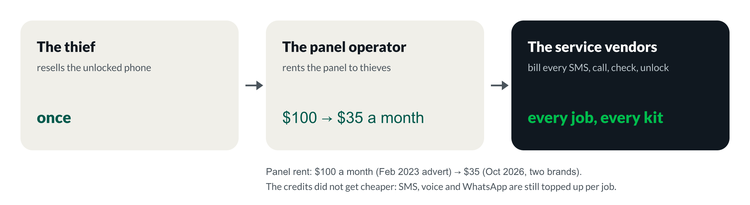
Figure 9. Three payouts for one stolen phone: panel-access rental prices fell between 2023 and 2026, while backend services continued to generate subscription and usage revenue
À la Carte
The services themselves are rarely advertised as standalone products. Instead, they are sold in bundles: rented platforms backed by menus of supporting services. We found six dated offers from February 2023 to October 2026, spanning both English-language and Spanish-language underground communities (Figure 10).
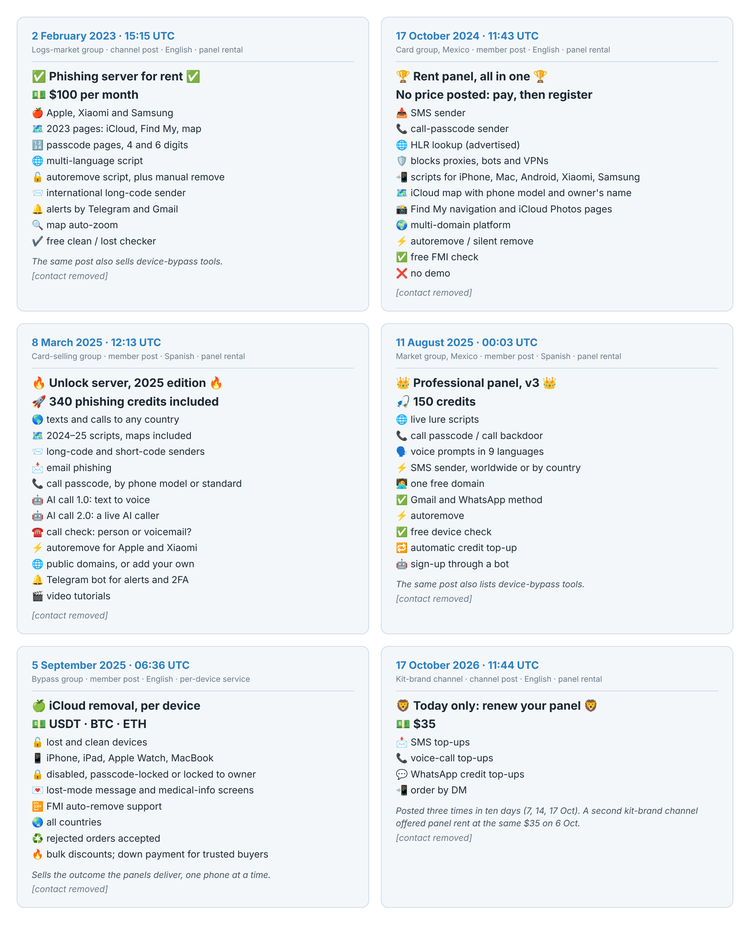
Figure 10. Six dated Telegram offers from February 2023 to October 2026: five advertise bundled panel and service packages, while one sells device removals on a per-device basis. Here, we have paraphrased, translated from Spanish, and redacted the sellers' wording, group names and post images.
The menus barely changed: lure creation, message delivery, voice prompts, device checks, and autoremove appeared again and again. By 2025, the bundles had expanded to include AI-generated voice lures, automated checks, and prepaid credits, with some advertisements promoting AI callers that could speak directly to victims and request unlock codes.
We recovered credentials related to these backend services from infostealer logs, including accounts dating back to 2022. Many account holders appeared to operate in the phone-unlock and GSM-server trade. This suggests an overlap between businesses that purchase legitimate unlocking tools and those renting access to the illicit unlocker and phishing layer.
The DNS Trail
Name Servers Tell All
These vendors do not hide well. Several run their own name servers on the same machine as the service. Search for every domain delegated to those name servers and much of the operation falls out: storefronts, panels, lures, and in one case, a kit's command server. These relationships aren’t just interesting to us; they’re useful.
Starting with 32 domains associated with backend services, infrastructure pivots led us to 173 additional domains. Even when a vendor moves, the DNS trail persists. For example, we observed one sender-ID shop register a new private name-server brand every few months and point its own domains at it. The trail is in DNS.
Panels Churn, Plumbing Stays
Front-end panel and lure domains are short-lived. Among the iRealm-family brands we tracked, half disappeared within 60 days of first being observed. The backend service domains supporting them remained active for a median of about 540 days, and the oldest was registered in 2019. Infrastructure pivots from those services revealed the same pattern: front-end panel and lure domains get detected and go dark, while 15 of 17 backend service domains remained online (Figure 11).
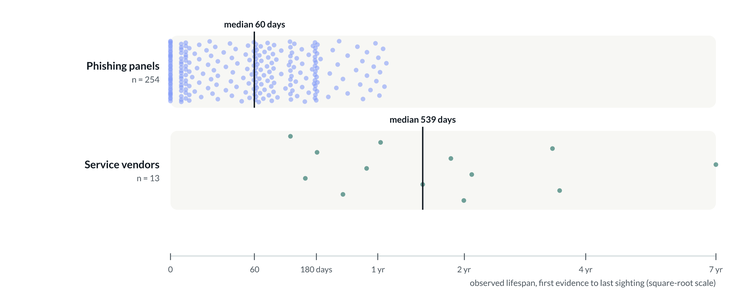
Figure 11. Observed lifespan of each domain from first evidence to last sighting through Oct 16, 2026. Each dot represents one domain; the tick marks the median. Front-end panel and lure domains churn in weeks; backend service domains persist for years. (Square-root day axis.)
The Phone, the Lure, the Vendor
The victim's "your phone has been found" message led to a phishing lure. That phishing lure depended on messaging services, map proxies, credential-validation services, autoremove platforms, and infrastructure providers. The brands may change, but the dependencies remain. Front-end panel and lure domains churn, operators switch kits and resellers, and familiar functionality reappears under new names. The service infrastructure supporting those operations is far more persistent.
Following those dependencies through DNS changes the view of the operation. Instead of seeing one lure, one panel, or even one kit family at a time, we can see infrastructure that connects multiple operators and, in some cases, multiple kit families. That is where the leverage sits. Kits can be copied, cracked, rebranded, or replaced. The services they depend on are fewer, longer-lived, and much harder to keep out of view.