
Powering the service provider
telco cloud
The safe, reliable and fast first-connection experiences that drive revenue and lock in loyalty



The performance and
protection service
providers need
to safeguard
their networks
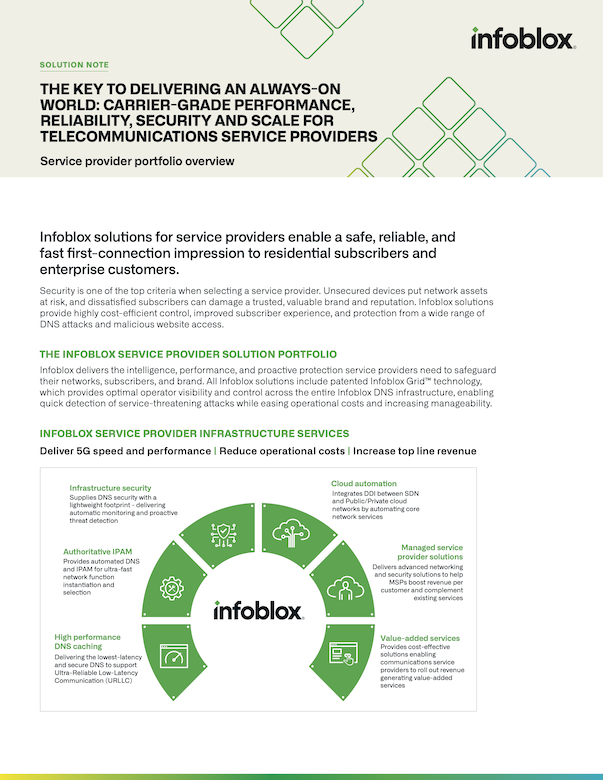
Infoblox solutions for service providers enable the crucial IP connections between your subscribers and their digital world. Our cloud-first networking technology provides carrier-grade security, five-nines reliability and ultra-low latency—all the capabilities you need to create a better first-connection impression for subscribers and, ultimately, smooth your transition to the 5G future.







“Not only was the Infoblox solution carrier grade and fit for purpose; it promised a high degree of scalability, which meant it would aid our rapid growth.”
Salem Moh Al-Marri, Senior Director, Core Networks, Ooredoo
“During the first, limited-scale deployment, an Infoblox partner implemented the DNS solution in just seven days for two of the service provider locations. This deployment showed that the Infoblox solution was easy to implement and stable, giving the provider confidence that the solution would work for large-scale deployments.”
EMEA-based Internet and Communications Provider
“The carrier can enable first responders with underlying endpoint security to report on blocked malicious attacks, define security policies and level of service, expand content filtering options and handle more granular reporting. Infoblox is an integral part of a suite of services whereby the company will supply secure end-to-end layered network services for public safety agencies.”
North American Communications Service Provider
Explore related solutions

Managed service provider
solutions
Develop and roll out profitable service offerings that solve customer challenges with deployment models that include on-premises, virtual and/or cloud-based services

Revenue-generating
subscriber services
Monetize core network assets while generating new revenue streams through intelligent, value-added services

Mobile service providers
Deliver safe and reliable 5G speed and performance while reducing operational costs

Cable and broadband providers
Accelerate telco cloud transformation while delivering the safest and fastest performance
Check out top products

Infoblox Threat Defense™
Quickly deploy on-premises, cloud or hybrid DNS-layer security everywhere
Infoblox Threat Defense™
Protect the network, subscribers and the brand with powerful DNS security in a lightweight footprint—delivering automatic monitoring and proactive threat detection

Cloud network automation
Centrally manage core network services and security
Cloud network automation
Automate core network services within the telco cloud by integrating DDI between SDN and public/private cloud networks

Know your network
Easily analyze your network and automate compliance
Know your network
Gain centralized visibility with data-driven insight so you can easily analyze, control and secure your network no matter how extensive or sophisticated it becomes